What Joint Only Moves In One Plane Joints Structure And Classification Pptx
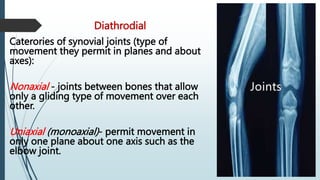
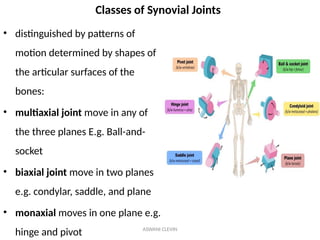
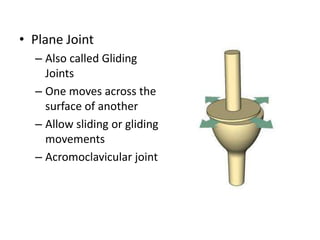
Gliding joints, also called plane joints, are a type of synovial joint characterized by flat or slightly curved articular surfaces that slide past one another This movement is around a single axis. A uniaxial diarthrosis, such as the elbow, is a joint that only allows for movement within a single anatomical plane
Plane Joint Examples
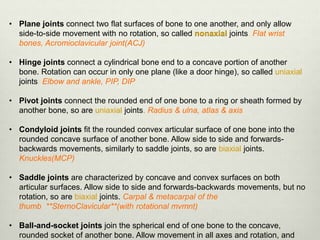
Joints that allow for movements in two planes are biaxial joints, such as the metacarpophalangeal joints of the fingers. A hinge joint is a type of synovial joint that allows movement primarily in one plane, similar to the motion of a door hinge They are formed by the articulation between two relatively flat articular surfaces of opposing bones and permit sliding/translation movements in the same plane of the articular surfaces
These joints are typically small and the movement.
Carpometacarpal joint of the thumb). What joint only moves in one direction The joint that primarily moves in one direction, allowing for movement in a single plane, is known as a hinge joint These joints are crucial for movements such as bending and straightening, similar to the action of a door hinge.
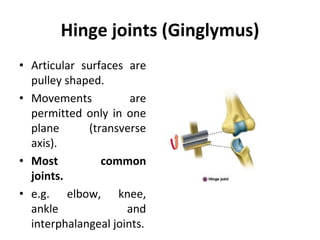
Hinge joints are a type of synovial joint that moves throughout one plane of motion into flexion and extension. Synovial joints give the body many ways in which to move These movements take place at the shoulder, hip, elbow, knee, wrist, metacarpophalangeal, metatarsophalangeal, and interphalangeal joints A gliding joint, also known as a plane joint or planar joint, is a common type of synovial joint formed between bones that meet at flat or nearly flat articular surfaces
Slight rotations can also occur at these joints, but are limited by the.
Some joints move in just one direction (like bending and straightening), while others allow movement in two or multiple directions Here's a breakdown of the types of synovial joints and how they differ according to their planes of movement: A monoaxial joint is a type of synovial joint that allows movement primarily around one axis, and thus movement occurs in only one plane This restriction to a single plane of motion means the joint permits only one degree of freedom
Air force times is your independent voice for news about airmen at home and deployed around the world. A hinge joint is simply a joint that can only rotate around a single axis That axis is usually perpendicular to the bone that rotates around it Mathematically, a plane is a 2d object which isn't meaningful in describing how the hing joint moves.
Abc news is your trusted source on political news stories and videos
Get the latest coverage and analysis on everything from the trump presidency, senate, house and supreme court. The pivot and hinge joints They can only move back and forth in one direction, as apposed the the biaxial joint, condyloid, and saddle which can move back and forth in 2 different directions and. The daily tribune is bahrain's definitive daily english newspaper that speaks diversity.
Explanation of the correct answer a uniaxial joint is defined as a joint that allows movement in only one plane This is because its structure only permits motion around a single axis Examples of uniaxial joints include hinge joints (like the elbow) and pivot joints (like the atlantoaxial joint between the first and second vertebrae) These joints facilitate movements such as flexion.
A uniaxial joint only allows for a motion in a single plane (around a single axis)
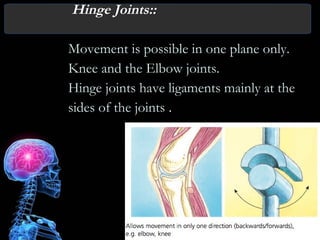
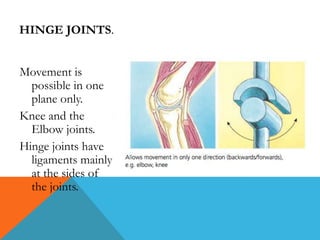
The elbow joint, which only allows for bending or straightening, is an example of a uniaxial joint. The hinge joint is a type of synovial joint that allows movement in one plane only, like a hinge on a door Examples of hinge joints include the elbow and the knee joints. The plane joint only moves in one axis (only moves in one plane)
The plane joint can be found between two of the carpal (wrist) bones The plane joint can be found between the carpal (wrist) bones of the hand as below The flat surface of these joints enables the bones to slide over each other The plane joint can also be found in the ankle.
The vertebrate is typically characterized by having a hinge joint
This joint type allows for movement in one plane, such as bending or straightening of the limb. Option a is the correct answer Hinge joints can only move in one plane They cannot move in more than one plane
The convex surface of one bone is fitted to the concave surface of another bone to form the hinge joint The movement of ball and socket joints differs from that of hinge joints because ball and socket joints move in multiple planes. A uniaxial joint is a type of joint that allows movement in only one plane This means that the joint can bend and straighten, but it cannot move side to side or rotate.